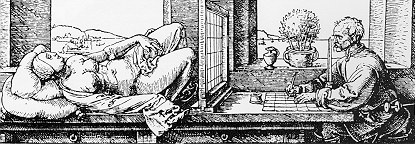
Though widely criticized by feminist film critics and revised by Mulvey herself, Laura Mulvey's notion of the cinematic male gaze has been widely adopted by feminist critics to trash Artemisia. Griselda Pollock, Shiela ffolliot, and Susan Fellman adopt a simplistic binary opposition between Artemisia as gazer and as gazed to deplore a transition in the opening credits from the focus on Artemisia's eye (drawing) to her drawing herself by candlelight (object of the gaze). The price of the clarity of their argument is its crudity; it is the product of an intellectual blindness to anything in the film that challenges and resists Mulvey's view of the male gaze. Artemisia is clearly both looking at herself and drawing herself, and she is not adopting pornographic poses, though she is posing. The rapid editing and quick changes of poses recall the quick eye movements of the very opening of the film. Moreover, the music on the soundtrack is similar in both scenes. And the reflection of the candlelight on her eyeball, the momentarily blackness as she shifts her view or blinks here eye, and the written credits suggest stains on her eye, a kind of blind spot, or what Jacques Lacan would call the objet petit a, the blind spot that structures vision (or what Paul de Man views as the blindness that enables insight). Artemisia's eyes are also wide open at various other scenes in the film involving sex and art. Thouogh Fellman and ffolliot have both used Duerer's woodcut to argue that the male gaze is sexist, they don't read the woodcut from the woman model's point of view, only the artist's. (See Freedman)
Thus, as Edward Snow points out in his essay on the male gaze, the limitations and problems of the male gaze the go unnoticed, as do the relation between error, blindness, discomfort, and perspective. The refusal to read from the model's point of view is oddly sexist. (One problem with the feminist attack on the film is that the attack is so focused on the artist as producer that it fails to attend to the artist as poser, or model; women models in the film are shown to be potentially disposable.) We will return to this issue when we get to Girl with a Pearl Earring.
The grid is also not really analogous to Merlet's Artemisia, as these critics maintain, in that Artemisia is on the side both of the model and the artist (simultaneously, at the beginning of the film and elsewhere) and in that Tassi is on both sides as well.
By attacking the film for adopting, so they say, a conventionally cinematic male gaze toward Artemisia, feminist critics end up resembling the Mother Superior who tries to use Artemisia drawings of her own nude body to shame her in the beginning of the film, the nuns who examine her, and the prosecutor at the trial who tries to use Artemisa's male nudes against her.
The film has been derided by art historians and film critics for departing from the chronology of her paintings established by R. Ward Bissell. It is easy to argue, however, that by having Artemisia begin her "Judith Beheading Holofernes" before the trial and using Tassi as her model, the film resists the sexist linking of her sex and art made by the prosecutor, who says that Artemisia has perhaps slept with twenty models for her twenty male nude drawings (see below) and here. The supposedly feminist attack on the film, in short, actually reproduces the sexist attack on Artemisia. The premise of a non-voyeuristic gaze one could oppose to the scopophilic, pathologized gaze is also, I would argue, untenable, and the pathologization of Artemisia's gaze in the film (strikingly articulated as "demented" by Felman) is also sexist as well as sex negative (men looking with pleasure at nude women is not only and always bad for all women, Felman implies, but women looking at men or women with pleasure is only and always bad for all women too). The film is much smarter than its critics, in my view, and it is clearly superior as a film to the clunky CBS and BBC documentaries. (Having what some would regard as the correct historical version does not mean that the film is any good, and vice versa.) Artemisia's feminism, I would argue, lies in its deconstruction of oppositions between male and female gaze, male and female artists and models, painting and pornography, real and fantasy, retrospection and prolepsis, progression and repetition, and sexual and artistic gazes.
The male gaze is not one thing in the film. Orazio and Tassi view Artemisia's work differently, though both are approving (Tassi not initially). Quorli is interested both in painting and in porn. And the male gaze is not always powerful.
The film also suggests that the gaze is not gendered. Artemisia looks the same way at the male body and at the female body. The film shows full frontal, flacid male nudity (a necessary absence, according to Mulvey), both of an actor and of Artemisia's drawings (see below). Artemisia's gaze is both artistic and sexual indeed, the film links the two, as when Artemisia makes out with the young fisherman, Fulvio (Yann Trégouët ), but only so she can draw him nude.
And the position of the male gaze, such as it exists in the film, is hardly one of mastery. Consider the scene in which Artemisia runs out of Orazio's studio and he looks through a grate, out of which she disappears (like the scene in prison where we see the camera move out to the landscape through the prison bars). Or consider the scene where Orazio looks into the studio to discover Tassi and Artemisia, half naked, looking at drawings. This scene is particularly interesting in that the two lovers are not caught having sex, as one is led to expect, but engaged in artistic appreciation. The same movement inside and outside is seen when Artemisia returns to the beach with the velo at the end of the film.
The film also dismantles the notion of the male gaze as violent because it focuses, in a supposedly fetishistic manner, on the woman's body parts, turning them into cut up fragments, so the argument oes, the better to master them. Merlet shows, in ways that reinforce Linda William's account of pornography as a desire for knowledge in her book Hardcore: the Frenzy of the Visible, that perspective necessarily involves fragmentation. The male nude is also seen in parts. The camera scans down Fulvio's body as Artemisia focuses on his hip,and her drawing of Fulvio shows his torso and thighs; it is not a complete study of his entire body. So too her drawings of herself are fragments.
Commiting a feminist "no no," the film shows the female gaze to be disapproving. The Mother Superior adn Artemisia's stepmother are both hostile to Artemisia's artisic endeavours, and the two nuns (a version of Judith and her maidservant to Artemisia's Holofernes?) who examine / rape Artemisia, one holding a candle, are a demonic parody of Artemisia's own "our bodies, ourselves" artistic and sexual self-explorations by candlelight.
Sex in the film is the occasion for pornography (during the orgy), which involves posing, and Artemisia also draws porn. Porn is also distinguished by the patron of porn from art. In terms of Artemisia's gaze, the scene is interesting for the way it bifurcates Artemisia's gaze. Initially, she find the sex funny (note too the candles, recalling the opening scenes where she draws herself by candlelight). When she goes to the second window and sees Tasssi having sex, the camera moves for the first time into the studio to show Artemisia look in from the outside. There is a shot from Tassi from inside the studio aligned with the window, then a shot outside showing Artemisia looking as Tassi is embarrassed to see her seeing him having sex. As she does at a number of points during the film, Artemisia runs away.
Attackers of the film have also paid no attention to the use of a female voice-over in the film. Artemisia uses it three times, near the beginning of the film, when finishing Judtih Beheading Holofernes, and at the end of the film, when she quotes Tassi's earlier voice-over. The gender default for the cinematic voice-over is male.
Similarly attacks on the film have ignored elements of gender confusion related to the male gaze, as when Tassi mistakes Artemisia, seen from her rear, for a boy (see below), and Tassi's bisexuality, hinted at in the orgy and when Tassi is in prison during the trial (see below).
The gaze is also obviously tied to perspective and the Alberti velo, later drawn by Duerer and sometimes called the Albrecht Duerer grid (even though he didn't invent it). The velo and perspective device Artemisia and Tassi look through suggest that there is only one gaze when it comes to perspective. The film is historicizing how learning to look through this perspective is very painful. This painful transition is also registered in the loose connection between various gratings, some of them prison bars, and the grid in the film. The camera often moves from outside to inside and back or through a grating, however, as if to suggest that the limits of perspective may be transcended. One coudl argue that the film does inscribe gender to show that the transition to perspective is more painful for women, signaled by the blood on Artemisia's fingers as well as her rape / examination by the two nuns, than for men (Tassi has blood on his hands, literally). The final shot of the film shows Artemisia's bandaged fingers with still red blood on the bandages.
In addition to the focus on Artemisia's eye and gaze at her body in the opening title sequence, the similarly focuses on her eye in the scenes where she discovers a couple having sex on a beach, her examination of a possible future husband, her seeing the orgy in the studio, her drawing the woman model, and her posing Tassi for her Judith, and her finishing her painting of Judith and Holofernes. There is also a p.o.v. sequence form Artemisia's perspective when she arrives for the trial in a coach (typically, we only realize it is her point of view after we get the p.o.v. shot) and in the trial itself after Tassi's wife testifies and says she is Tassi's wife.


Artemisia's assembles a portfolio with her male nudes to show Tassi to get him to teach her perspective.


Tassi is midly shocked by the male nudes and declines to teach Artemisia.


Afer running off, Artemisia drops her portfolio, and the camera focuses on one of her male nudes blown away by the wind.


Between Artemisia drawing the woman model with tassi's help and drawing Tassi the first time (clothed) we see again Artemisia's male nudes.


As the Mother Superior tried to use Artemisia drawings of her own nude body to shame her in the beginning of the film, the prosecutor at the trial tries to use Artemisa's male nudes against her. Similarly, he connects the painting to Tassi to show how warped Artemisia is.


In a scene with gay resonances, Artemisia is mistaken for a boy by Tassi. Note the prominence of her read end.


During the orgy, Tassi and the porn patron, Cosimo Quorli, also embrace and exchange looks in a way that hints they have been or are lovers. The conversation, to be sure, about Tassi keeping his clients, and Quorli does touch a woman's breast at the end of the scene.


They also seem quite intimate in prison after Tassi's wife shows up at the trial.
