Artemisia has been derided by art historians and film critics for "grossly distorting" the chronology of her paintings established by R. Ward Bissell. Artemisia painting herself is seen early in the film (her self-portait is taken to be a late work).
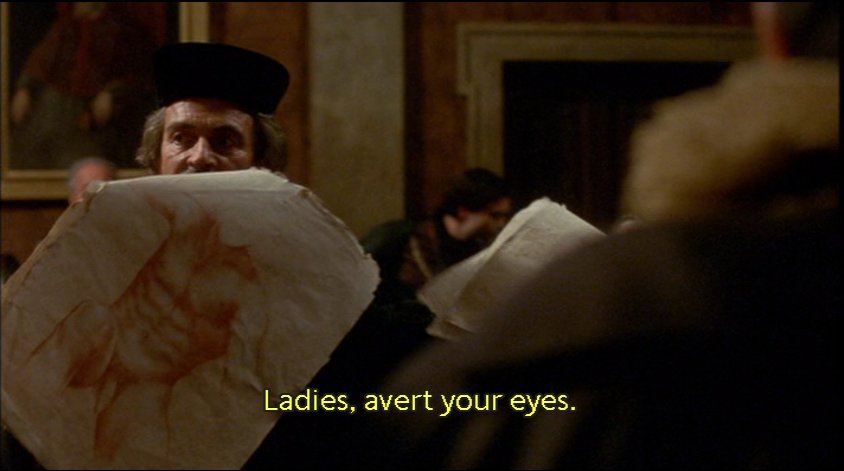
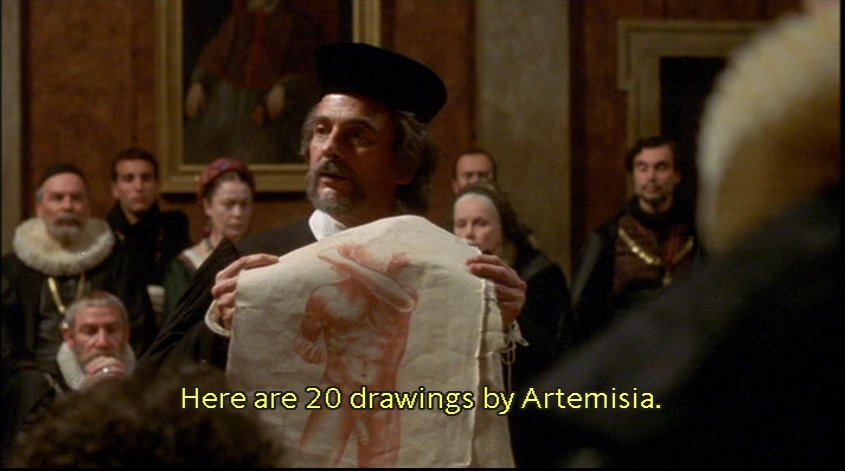
The film clearly ignores Bissell's chronology for its own reasons. Merlet narrates a progression from the opening scene of self-examination to her first painting (in her own make shift studio) of herself (since she has no models to paint). The progression is not straightforward, however, since Artemisia has already begun drawing male nudes. Also, the film offers different chronologies, or narratives. The closing credits chart a progression of sorts through fragments of two paintings, framed as iris camera shots that recall the framing of Artemisia's hands in the last shot of hte film: two parts of Susanna's sexual harassment by the two elders are seen first, then two parts of Judith and her maid servant carrying Holofernes' head. Artemisia both offers a progression narrative and calls the notion of artistic progession into question. I would argue that the film's feminism lies in is resistance to a narrative of progression from life to painting (to a biographical reading of the paintings). By having Artemisia begin her "Judith Beheading Holofernes" before the trial and using Tassi as her model, the film resists the sexist linking of her sexual experience (consensual or rape) and art made by the prosecutor, who says that Artemisia has perhaps slept with twenty models for her twenty male nude drawings (see below) and here. Most feminist attacks on the film, in short, actually reproduce the sexist, misogynistic attack on Artemisia they supposedly is fighting against. Pollock herself goes out of her way to delink the art from the rape in Differencing the Canon (she declined to serve as a talking head or consultant for a BBC documentary; see also Laura Benedetti's essay for a similar move.) The two documentaries by CBC and BBC tv about Artemisia, especially the CBC one, do just the opposite. (Through a dissolve, the CBC documentary merges blood from Holofernes running down the painintg with blood running down the bedsheet on which Artemisia has just been raped.) Furthermore, the scenes where Artemisia paints and draws in voice-over give a naratative that is fragented, and the fragmentation of writing painting and drawing, as it were, is often metaphorized through body parts and motions.
In my view, the often over the top bashings and thrashings art historians have given the film may be explained not in terms of the film's "betrayal" of the historical chronology or its alleged "insults" to the record (the trial tanscripts) since biopics and documentaries are never entirely accurate, but in the way Merlet's film challenges the academic feminist fantasy about Artemisia, the icon (the "real" Artemisia remains necessarily an interpretation, a fiction of historians as much as of novelists and filmmakers). Just as Margaret Rosenthal wants to liberate the "real" Veronica Franco from romanticized accounts of her sex life, so Garrard wants to liberated Artemisia from the sexual scandals surrounding her paintings,and from readings of her paintings that cantain any trace of sexualization. Yet both Rosenthal's and Garrard's accounts involve their own romanticism of women poets and artists, a highly idealized, chaste (asexual) notion of the heroic woman artist totally divorced from sex ("sexualization" is thought to be something that is done to women, as if sexuality were not part of women). More fully and more sharply than Dangerous Beauty, the film Artemisia directly challenges is this 1970s essentialist feminist romance of the woman artist in the name of a far more intelligent, complicated, and in my view, liberated, feminist analysis of female art and sexuality, one that eschews the rigid, simplistic, and sexist oppositions between subject / object, sexualization / desexualization that structure so much so-called feminist criticism.
The real provocation of Merlet's film is not that it romanticizes rape (it doesn't) but that it places shock, pain, and error inside of romance. It follows out, indirectly, a psychoanalytic account of adult sexuality. According to Jean Laplanche "the adult world is infiltrated with unconscious and sexual significations, of which the adult too does not possess the codes" ( 1992, 188). Slavoj Zizek's move on Laplance is to show that violence is inherent in adult sexuality because it is enigmatic. Zizek manitains that "the whole construction of the scene of primordial seduction holds only if we presuppose that it is not only the observing and / or victimized child for whom the scene is impenetrable and enigmatic--what baffles the observing / victimizing child is the fact that he is witnessing a scene which is obviously impenetrable also to the active adult perpetrators themselves--that is, they too, 'don't know what they're doing'. . . . We are thus dealing with the structure of a temporal loop. There is sexuality not only because of a gap between adult sexuality and the child's unprepared gaze traumatized by its display, but because this child's perplexity continues to sustain adult sexuality itself. This paradox also explains the blind spot of the topic of sexual harassment: there is no sex without some element of 'harassment' (of the perplexed gaze violently shocked, traumatized, by the uncanny character of what is going on). The protest against sexual harassment, against violently imposed sex, is thus the ultimately the protest against sex as such: if one subtracts from the sexual interplay its painfully traumatic character, the remainder is no longer sexual. "Mature" sex between the proverbial consenting adults, deprived of the traumatic element of shocking imposition, is by definition desexualized, turned into mechanic coupling." (The Ticklish Subject : the Absent Closure of Political Ontology [Verso, 1999], 284- 286). More concrete and coherent than Zizek, whose notion of violence remains disturbingly evasive (at turns both metaphorical and literal) and which appears to extend Andrea Dowkin's account of all heterosexual sexual intercourse as rape in her book Intercourse to now include all sexualized contact that precedes and follows the sex act, now defined as sexual harassment, Merlet distinguishes violence that inheres in the temporal loop of sexuality and romance (which is both the shock of the gaze that does not understand and the physical pain due to the loss of virginity) from the violently imposed sex we may define either as rape or as sexual harassment. For Merlet, this violence is gendered (women experience it and are vulnerable to it in ways that men do not and are not).
The sexist prosecutor "concerned" with his female audience as he shows the evidence of Artemisia's "depravity." How different is his attack on Artemisia from the feminist attack on the film, insofar as both read the paintings in relation to the life? (Tassi's mistake in the film is to read the drawings similarly as evidence of Artemisia's sexual experience.)