
A film clip analysis and plot segmentation analysis due February 1 by 8 p.m.
First paper 3k words First Paper: Due Friday, February 15 by 8 p.m.
Draw on at least one of the required books and do any of the following options based on the topics below, writing on at least one film we have not discussed in class for each paper:
Compare a silent Lang film with a talkie Lang film. Or ditto for Hitchcock.
Compare a Hitchcock film with a Hitchcockian film. Psycho and Dressed to Kill, for example.
Compare a Lang film noir with a related film noir; ditto for his Westerns. For example, compare Human Desire and Gilda, or You Only Live Once and Detour.
Compare a Hitchcock film and a Lang film (an obvious pairing would be The Wrong Man and Beyond a Reasonable Doubt; similarly, one could link Strangers on a Train and Human Desire). Compare a Hitchcock remake (The Man Who Knew Too Much) or a Lang remake (The Secret Beyond the Door as a remake of Spellbound and Rebecca or Human Desire as a remake of La bete Humaine).
Another example would be The Ministry of Fear and The 39 Steps. Or consider Murder! and The Blue Gardenia (or Murder! and The Wrong Man, or Psycho and The Blue Gardenia [see the dream murder sequence with the water going down a drain like the end of the shower scene in Psycho and the knife held by one of the three roomates that resembelshte one Noramn uses).
Second paper 3k words Second Paper: Due Friday, April 18 by 8 p.m.
"Hitchockian" is an adjective commonly used to described films Hitchcock didn't make. "Langian" is not an adjective employed in the same way. Although "Hitchockian" would seem to be derived from Hitchcock's films, we will ask what "Hitchcockian" means (other than "master of suspense" and whether Lang's films are more Hitchcockian than Hitchcock's (Human Desire, for example, is arguably more Hitchcockian than Strangers on a Train (the ending cuts between the engineer car and the passenger car in Human Desire being like the carousel sequence at the end of Strangers on a Train (Lang made an adaptation of Carousel entiltled Liliom). We'll examine subsets of the question: Is Hitchcock's remake of The Man Who Knew Too Much more Hitchcockian than the original? Are some of his films more Hitcockian than the others? Do parodies like High Anxiety and The Man Who Knew Too Little tell us more about Hitchcock than Hitchock's films do? Are De Palma's, Powell's or Mel Brooks' films more Hitchcockian than Hitchcock's?
We will also consider what "Langian" means, focusing on the way his career is often split between his German films and his American films (see Tom Conley, film hieroglyphs). We will focus largely on Lang's American films, taking their wide range and, in the view of some, apparent lack of unity, as our point of departure, and examine his reception by Siegfried Kracauer (who regarded his films as proto-Nazi) in From Caligari to Hitler and the Marxist New Wave film directors Jacque Rivette in the Babel sequence of Paris Belongs to Us and the scene of the screening of rushes from Lang's Odyessy and discussion of Lang's M and Rancho Notorious in Godard's Contempt. We also look at Madonna's music video "Express Yourself" in relation to Lang's Metropolis. I will contend that the German and American films have deep continuities, despite Lang's collabration with Thea Harbou, who stayed behind in Nazi Germany, in Spies, Die Niebelungun, Der Muede Tod, Metropolis and Die Frau im Mund, among others.
Whereas Hitchcock made films in the more or less the same genre in different ways, Lang made films in different genres the same way.
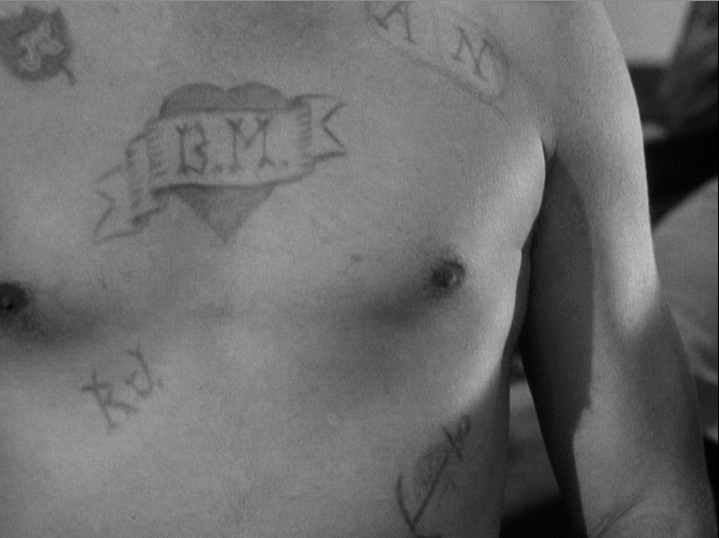
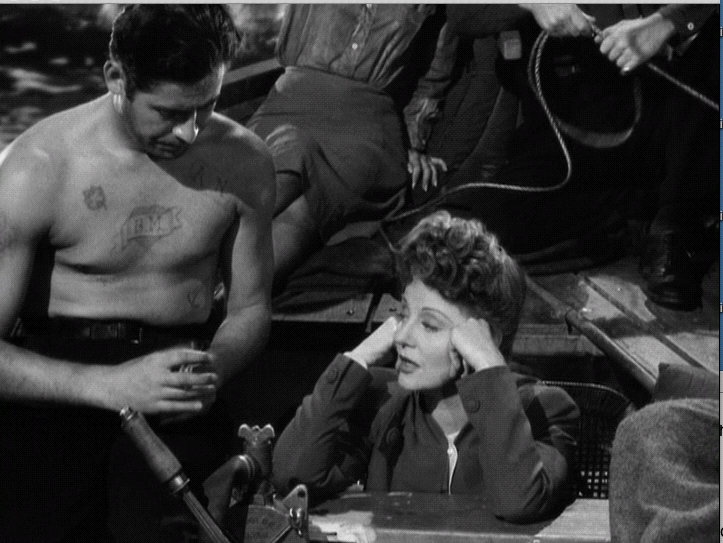
Lang and Hitchcock share interests in letters, especially the letter "M," and writing in their films often signifies, especially in relation to names. Consider "JJ, "HH," and "FFollitt" in Foreign Correspondent or Chris Cross (Edward G. Robinson) in Scarlet Street. See also the initials "E T" on the inside of Henry Fonda's hat in You Only Live Once and the tatooed initials on John Hodiak's chest in Lifeboat, on which the camera closes in and about which Tulalah Bankhead inquires, asking about BM in particular (bowel movement?) More on initials.
 |
 |
Lang and Hitchcock also share an interest in various kindes of non-alphabetic graphic marks or film hieroglyphs. The two direcrors cast some of the same actors and actresses. Michael Redgrave is the lead in The Lady Vanishes and The Secret Beyond the Door. Peter Lorre starred in M and The Man Who Knew Too Much and The Secret Agent. Marlene Dietrich starred in Rancho Notorious and Stage Fright. Joan Fonatine starred in Rebecca, Suspicion, and Beyond a Reasonable Doubt. Henry Fonda starred in The Wrong Man and You Only Live Once and The Return of Frank James. Sylvia Sidney stars in Fury, You and Me, and You Only Live Once as well as Sabotage.
Additionally, both directors left their countries of origin and moved to Hollywood (Lang returned to Germany at the end of his career to make his last three films, and he also appeared in Jean Luc-Godard's Contempt, filmed at Cinecitta). Both men cite Freudian psychoanalysis in their films (Dr Mabuse the Gambler, Ministry of Fear, The Secret Beyond the Door, Spellbound) and were involved in the Allied war effort and made anti-fascist films. Yet both men directed films with very elusive politics, though their films may seem generally liberal-minded. Both were interested in plots that involve a criss-cross in which the hero is also a villain or the double of a villain (a victim and a villain) or the villain is also heroic (the Nazi U-boat captain who first saves Gus's life and then later murders him in Lifeboat).
Moreover, they are often interested in plots involving redos: a character chooses one love object instead of another and the outcome is the same (it's a bummer). See They Clash by Night, Rancho Notorious, and the two letters in The Blue Gardenia, the first from the heroine Nor's (Anne Sothern) fiance and the second from a reporter, both duming the heroine (the reporter quotes the sign of the first letter "with best wishes for your future" when composing his letter). A switchboard operator, Nora is also mistaken on the phone for a roommate, identified by the reporter through her phone number as if it were her name, who is nearly her double. A shot of "Information" also shows up in the film noir screwball comedy You and Me just before the couple marry. Information and disinformation always overlap.
Thematic detail: Gus's shoe after he is left is amputated in lifeboat--he uses the shoelace to get seawater from a cup to drink and a sailor uses it to help kill the Nazi captain who pushes Gus overboard.
Both directors' strongest films are typically their darkest (though not all dark Hitchcock films are good, and we will want to define carefully what makes a "good" film "good"). Both directors are similarly drawn to plots and themes that involve the subversion of democracy, Nazis, trains (the railroad company is associated with evil in The Return of Frank James) murder, memory and (writing and / as war ) machines, figures of cinema (the assasin / executioner in Hangmen Also Die goes to the cinema to evade capture), global conspiracies, crime detection, indexicality and identification (fingerprints), telephones, Freud and dreams, the uncanny, the double, and repetition compulsion, the archive, the library, time (clocks), lighters, trains, schedules, voyeurism, the wrong man as the suspect of an investigation by criminals and / or the state, figures framing (window, door, etc) the law, revenge, commonalities between criminals and police (nad nazis and their resisters--"terror for terror!" is one of the slogans of the anti-Nazi Czechs in Hangmen Also Die), and the themes of marriage, death, paranoic suspicion, and revenge.
Both were very alert to film sound, especially Hitchcock. Dialogue is drowned out in many of his films. See the telephone booth scene and the unheard joke at the end of Blackmail or Devlin (Cary Grant) walking with the Professor (Leo G. Carroll) toward the airplane before boarding it in North by Northwest. Hitchcock also innovated in the opening title sequence (see Vertigo). See, for a Lang example, the record playing the "Liebestod" from Richard Wagner's Tristan und Isolde at the murder scene in The Blue Gardenia, then returning as apparently extra-diegetic music, then identified as diegetic ("canned") in an airport lounge, then continued as extra-diegetic through an extended confession of the real murderess and her flashback scene where we see the actual record being put on the player and the needle touching the record even as the music remains extra-diegetic, shifting from the prelude to the Liebestod. The opera recording is barely identified visually in the film. Wee the record held briefly in one shot next to the cop's badge, and we can see, but really only in the DVD capture because the take is so brief and the movement of the cop draws our attention to his badge, the title of the opera and "Liebestod" and "(Love Death)" written below it. This is one of many examples of "LangesTod." Tristan has also been linked to Vertigo.
 |
 |
Compare the discovery of Dr. Baum / Dr. Mabuse's voice on a record in The Testament of Dr. Mabuse. For other examples, see Michel Chion, The Voice in Cinema.
Compare also Nat King Cole's "Blue Cardenia" in The Blue Gardenia and Doris Day's "Que Sera Sera" in The Man Who Knew Too Much.
Lang was especially interested in destiny and death. He never worked in television, as did Hitchcock.
The train in Double Indemnity
Berlin Express