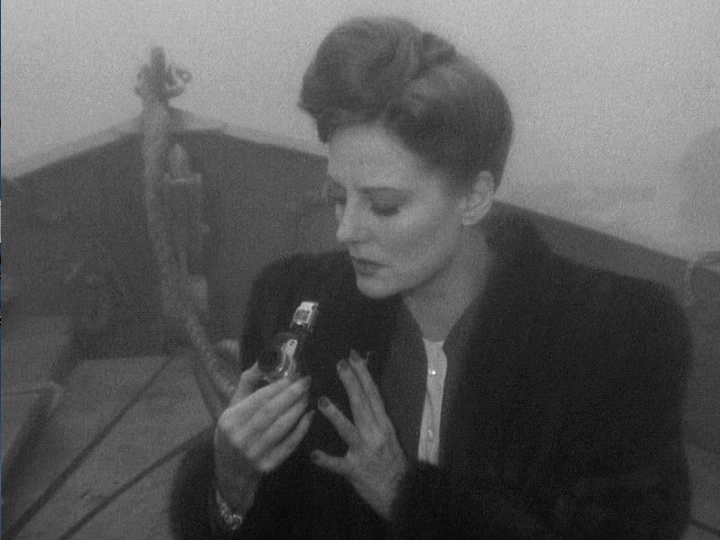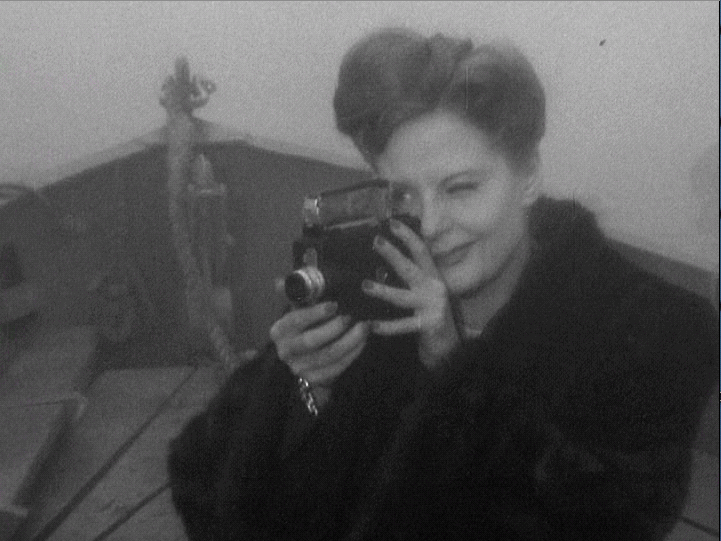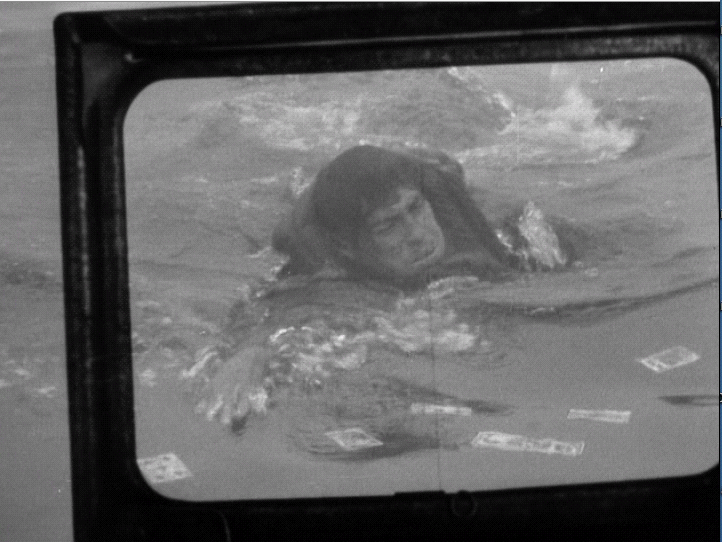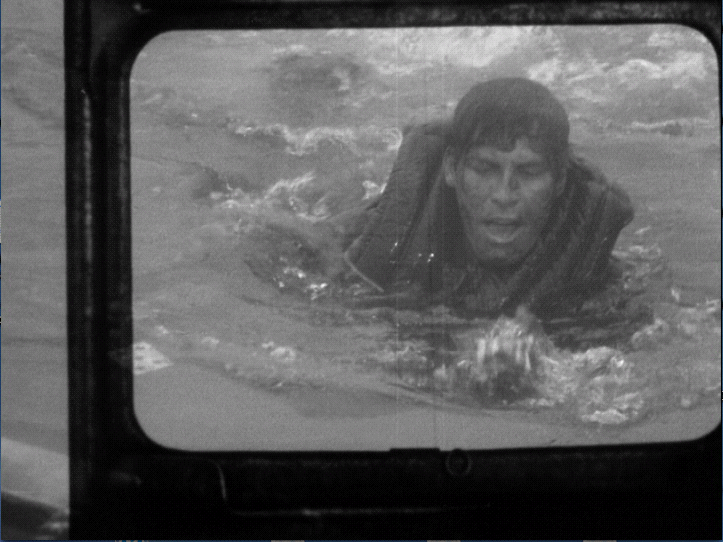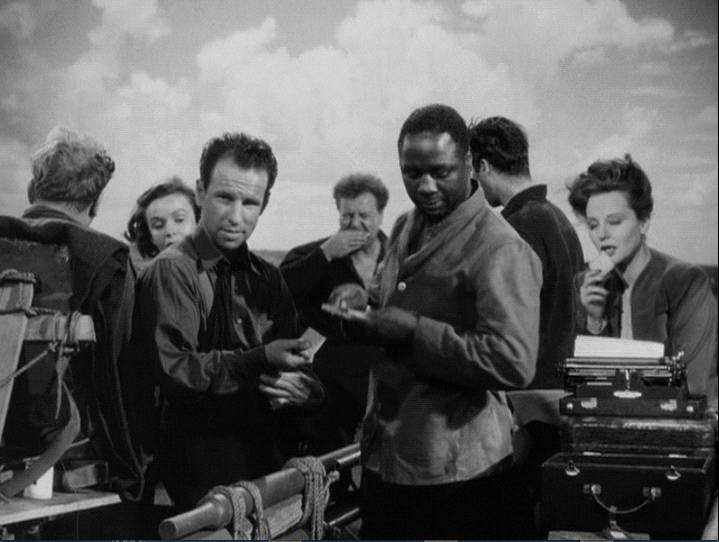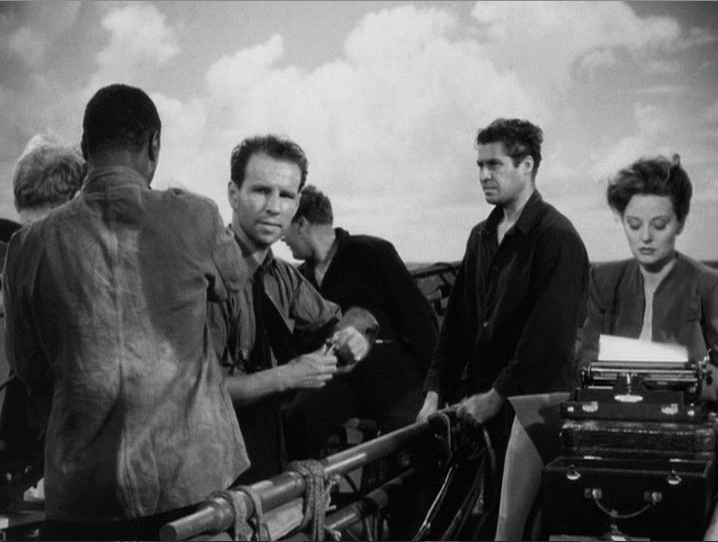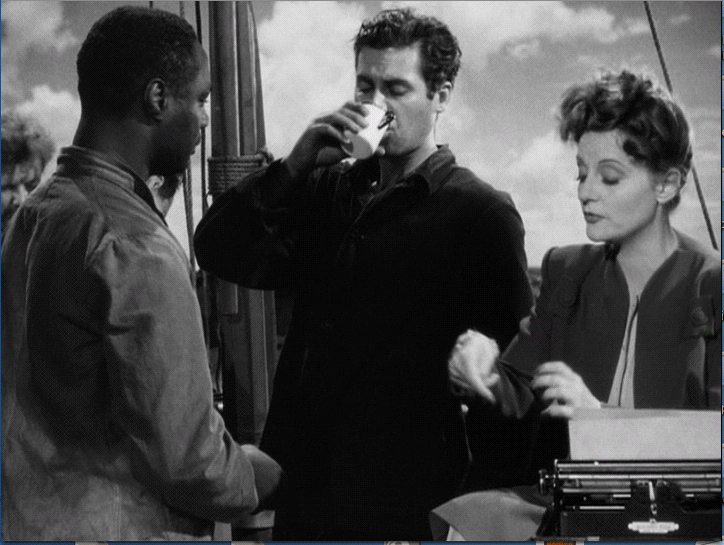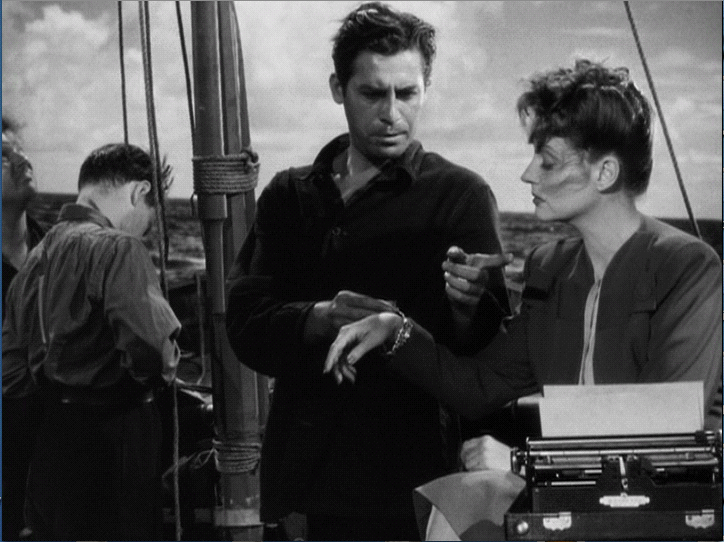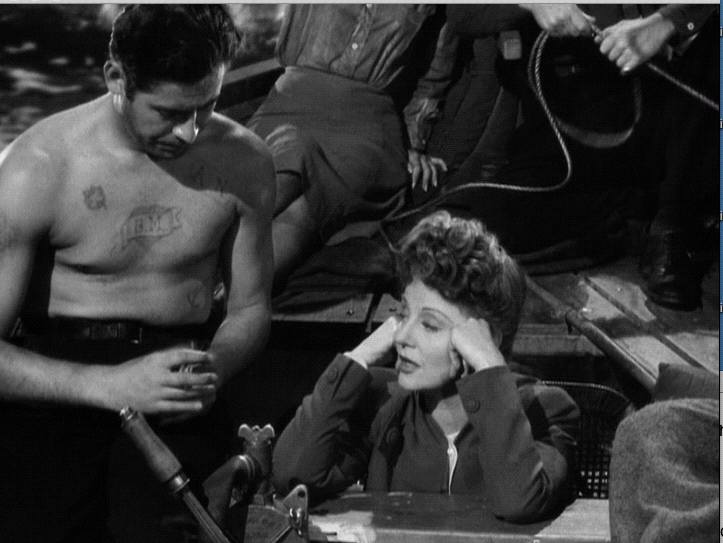
Example of a report on a scene from a film (see the screen captures of four shots in a sequence from Lifeboat below). Give the time of the shots as they occur in the DVD (or video, if the film has never been released on DVD). Describe each shot as in the film analysis (kind of shot, length of the take, lighting, angle, etc). Either put the shots and info online and send me the URL or pass out handouts in class with the shots and info. Provide some context for the two scenes in your report and how it contributes to your reading of the film as a whole. As a second scene, I would do the opening of the film.
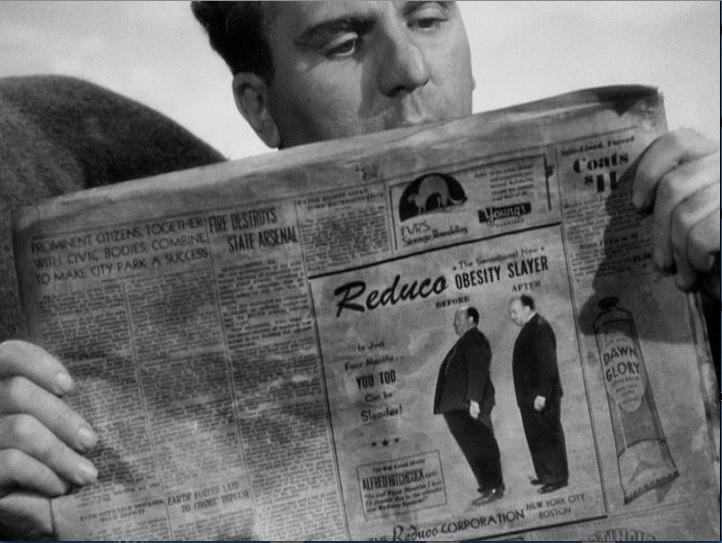
Note that Hitchcock's cameo appears earlier this sequence in contrasting profile before and after shots for a weight loss "Obesity Slayer" advertisement in the newspaper. His name appears in the advertisement. Notice the headlines as well.
Shot 1: Up, Periscope: Ueberlesen (Overreading)
A shot of a newspaper that is not precded by a shot of the person reading it. The newspaper has a phantom reader. We are literally reading over someone's shoulder here since this is not a p.o.v. shot.
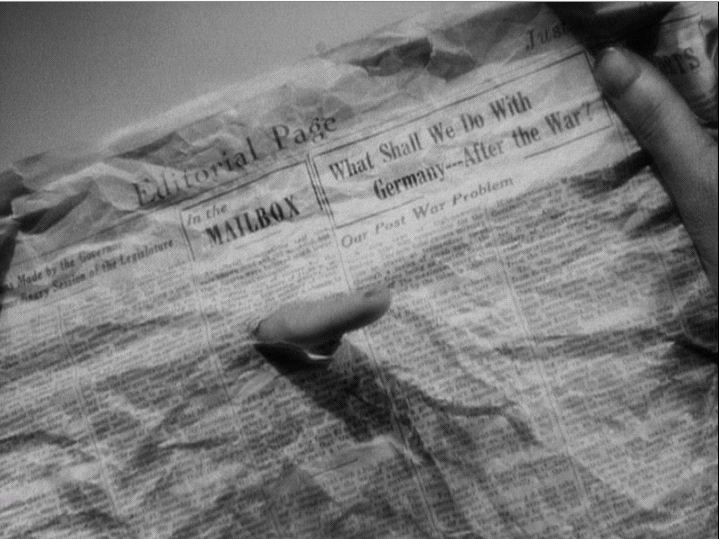
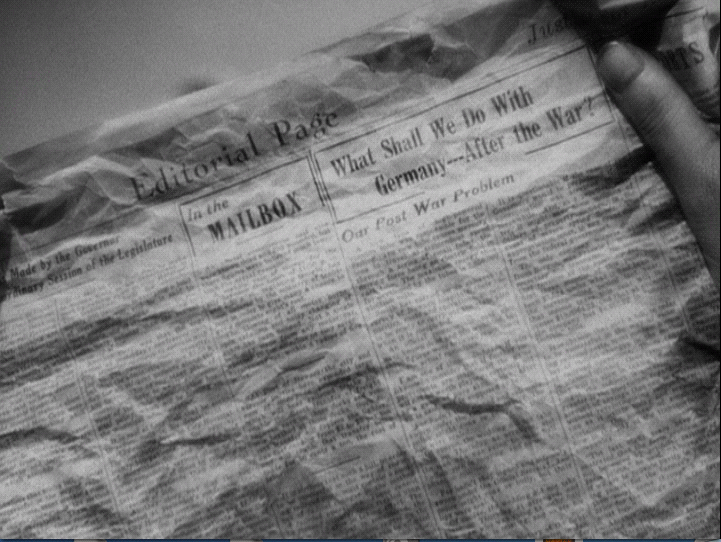
Bankhead's inquiry about the intitals follows after a shot of a newspaper Hodiak is reading with the headline "What Shall We Do with Germany--After the War?" and the subheading "Our Postwar Problem." The paper is pierced by Bankhead's finger, heard with a tearing sound, followed by a blurry Sleazak in the background and Bankhead's smiling blurred head coming across the shot. The finger comes up like periscope, as a figure which over reads but also disrupts (our) reading, or one possible way of reading the future as a problem to be solved. Is there a "post" war? Or will war continue even after victory has been declared and one side has officially surrended to the other? Note also the boxed "In the mailbox" and the obvious datedness of the newspaper. News arrives, but is also delayed, late, boxed in (like the survivors in the boat).
Note: there are also scenes of reading newspapers and looking over the page in The 39th Steps (in the train car with the lingeries salesmen and reverend, not connecting Hanney to the newspaper they read about him, an accused murderer) and again at the farmer's house (the young wife and Hanney exchange glances as the farmer says grace and opens one eye to see what's going on) and in Shadow of a Doubt (Uncle Charlies reads the paper).
Shot 2:
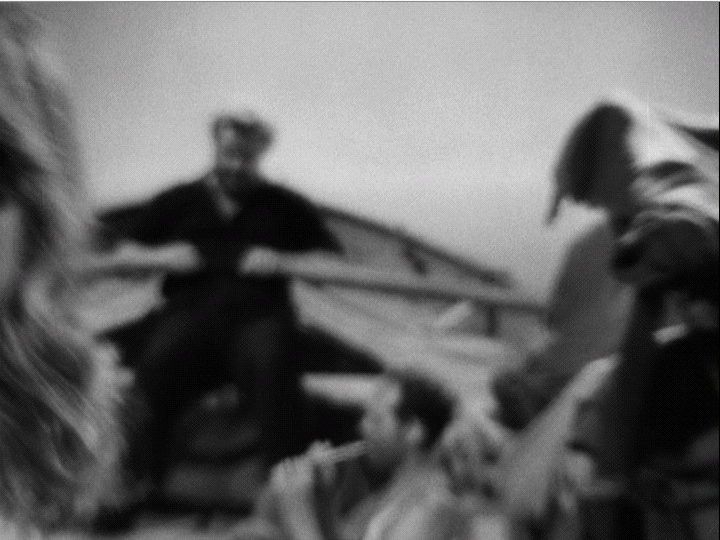
“Dive, Dive, Dive!" Untenlesen (under reading).
Bankhead reads Hodiak from below, positioning the spectator again in Hodiak's place (we read the newspaper as he does).
Shot 3:
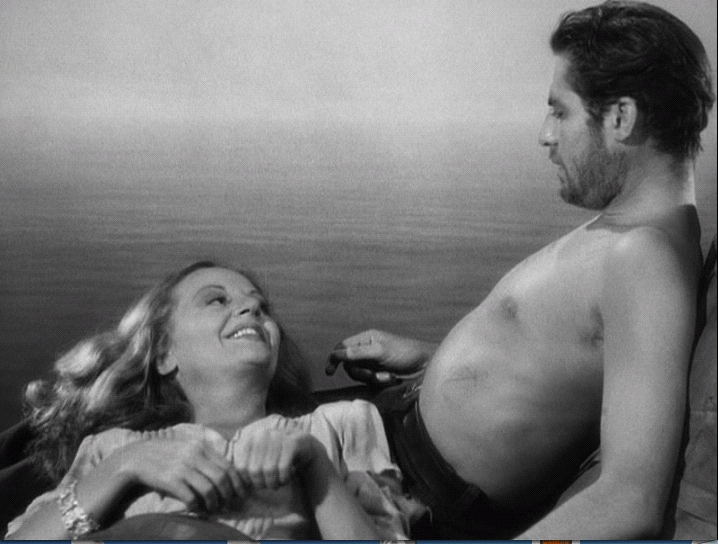
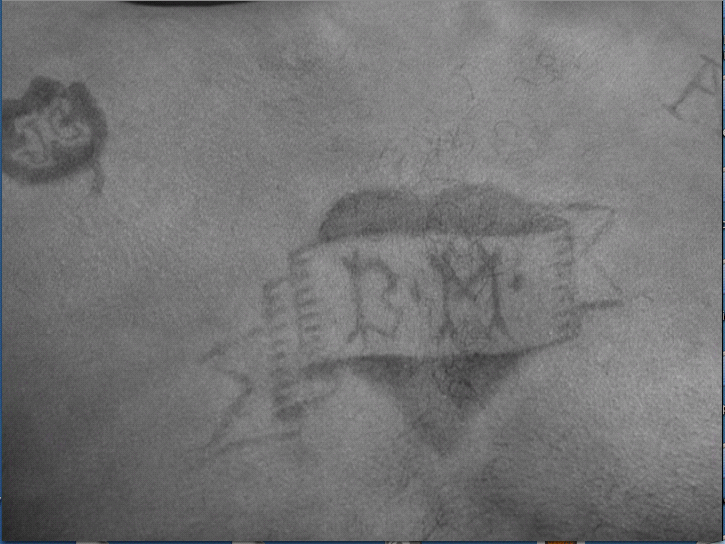
Shot 4: Unlike the other initials, "B.M." are written on a banner.
For a reading of "BM"in Shadow of a Doubt, click here.
See Tom Cohen's brief entry on "bm" in Crytpnomies (vol 1), chapter 2, "A User's Guide."
A shot of Bankhead putting her head on Kodiak's lap is followed by a close up of the letters "B.M." on Kodiak's chest. The recording and questioning of the future is represented as problem of inscription and its disruption by a woman's finger and her ability to read (put her finger on, or in) a man's romantic history as inscribed on his body. Bankhead points out that these letters are larger than the others and wonders if are they name his first love or his last, taking the difference in the size of letters to mark a narrative or narratanbe sequence tha is nevertheless indeterminate. (Does war have a beginning and / or an end? Lifeboat opens with the sinking of an Allied ship, but the last item seen in the lengthy first take as the ocean flows to the left is a German life preserver--so the sinker has also been sunk, which is also where the film ends, sort of, but we have to read the narrative only by looking at the flotsam left on the surface; no depth charged reading, as it were, is possible). Bankhead's intrusion into the newspaper with her finger echoes her use of the camera at the start of the film and her typewriter, both means of inscription and both thrown overboard (what Kodiak calls her "handcuff," or bejeweled bracelet, is also lost later to a fish, and transformed through a continuity error into a ring). Similarly, her blurred face and Sleazak's blurred body echo their linkage through their command of foreign languages (they both are fluent in English, German, and French). Moreover, Bankhead is the first on the boat (it's something of a mystery exactly how she got there; "ladies first" doesn't explain it) and U boat captain is the last one on. Their order is echoed by her question about the initials B.M.--first or last? The central problem the survivors face is how and when to make their move(ment). The political problem is also a narratological problem (figuring out the order or Ordnung of events).
The one continuity error in a fakey movie (all studio shots of the actors and rear
projection footage of the ocean) involves the one underwater shot in the film, namely, the shot of the fish taking the bracelet
turned into a ring as bait.
The depths are not to be trusted (to trust them is to "take the bait").
Yet the spectator's reception of the surface is set at a paranoic
default. How much is the surface to be trusted? Are we overreading
(reading into things) by reading the film very closely? Or are we
underreading, not reading closely enough? Does "B.M." signify anything? Or is it a signification of insignificance (as BM, a "shitty" reading) or the insignificance of reading in general as a waste of time, passing the time, diversion and distraction? Does "B.M." signify in other ways? "Best Man?" "Blackmail?" "Blocked movement (constipation)?" Does this (a)reading put Lee Edelman's anal as opposed to phallic reading of Hitchcock in the shitter, as it were?
A simple anti-Hitchcockian feministic criticism (see The Women Who Knew Too Much) would see here a struggle over power reduced to an instrumental understanding of communications technology as a weapon (to be wielded like a club)--who controls it, who writes the script of history and who shoots it. But Hitchcock figures that gender struggle much more precisely in spatial terms as a question of over and underreading that arises from an inability see below the surface. Note the recurrent use of zooms on significant objects, like the empty chair of the woman whose baby drowned (was she murdered? or did she finally succeed in committing suicide?) and Gus's empty shoe after his leg is cut off). Neither Kodiak nor Bankhead are reliable authority figures in the film, and she shares unsavory aspects of the U-Boat captain, especially when she defends their murder of him on grounds that he would have taken them to concentration camps. Her feminism is just as aberrant and queer as Kodiak's macho posing.
Kodiak is initially a worker figure (John Steinbeck as proterlarian
novelist). But he becomes a sort of sellout by the end of the film--Henry Hull grabs some
cash before he gets in the boat--but Kodiak wins the poker game (we don't
know if Hull is lying or not)--we don't see his cards. So the deal is
at the end that Hull will give Kodiak the 50k he owes him and Kodiak
will apprently manage one of his plants with his new but as yet unarticulated
labor management plan.