Back from the (En)grave(d)
In Shadow of a Doubt, Uncle Charlie follows his niece Charlie into the kitchen after giving all the other family members gifts. Charlie has said she doesn't want one. He gives her a ring anyway, though we don't actually see a ring when he touches her hand. Only when she holds it up do we retrospectively think that he must have given it to her in the previous shot.
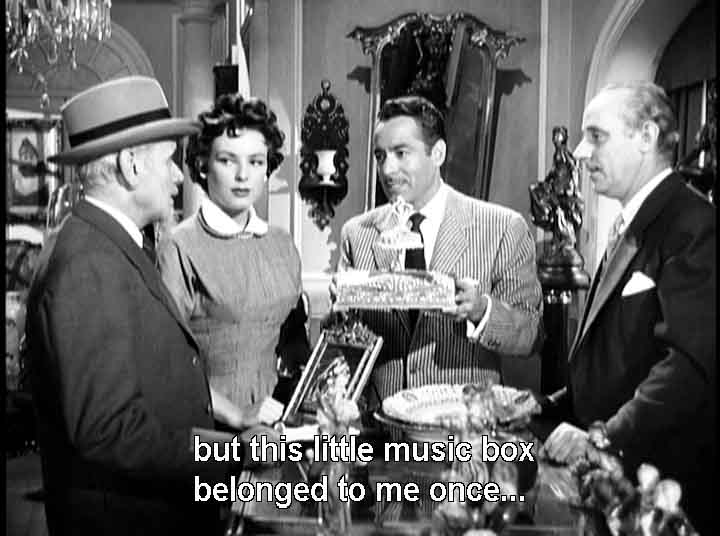
She reads aloud an inscription Charlie missed on the inside of the ring: "ts from bm" and we hear her read it as we see the inscription in close up. Here we have another example of underreading, literalized in the wedding ring, which encrypts the inscrition by making it invisible once hte rng is where it is destined to be, namely, on the wife's wedding finger. It's a forgotten message. Here it returns as a reminder or clue that Uncle Charlie is a serial murderer--he took the ring off of one of the widows he murdered. Now we have a kind of forever unreadable formula--"rt+2=bm"--generated by the ring's perverse recirculation between an uncle and his niece. Or we can hear it as "'tis from bm." Some the origin from which all things come is bm, in the rim in the ring, or hole. The scene is set up in a romantic way, as if Uncle Charlie and Charlie were lovers (or wanted to be). Charlie is giving his niece a kind of rim job. When she puts it on and won't return it to let him have the initials take off, he's screwed. the scene of death is also a scene of death's inscription (as en-graving). Uncle Charlies gravy train has stopped, after all, in Santa Rosa.
This ring scene follows earlier telegram and telephone scenes in the film announcing, via delays, Uncle Charlie's arrival.
The same scene precedes a newspaper reading scene in which uncle Charlie tears about part of a page to build afake house for a nephew, a page that has news of a dead woman he murdered. This is the very page that Cahrlie later sees hidden in his coat pocket. When she takes it out, he stands up and grabs her hands, hurting her even though she does not realize she is exposing a bigger lie than she is (un)able to read in the discarded piece of newspaper.
The cameo in Stagefright follows a scene involving the heroine (Jane's Wyman) disguising herself as the maid Doris Tisdale in which she wears her aunt's eyeglasses, though which she (and we) cannot see clearly. Mirror images double her before Hitchcok looks back at her and then turns his back on us (as in The Lodger).