NOTE: All assigned work for this course must be completed and be of passing quality to pass. We will learn collaboratively. I will not lecture at you while you try to stay awake. Therefore, you and your fellow students must all participate in class discussion. This is a new and somewhat experimental course I have designed myself. To get above a C, you must participate in class discussion. All assigned work for the course must be completed, turned in on time, and be of passing quality to pass the course.
Do any required readings have to be print, not electronic?
Your final gade in the course will be based on the following:
Three Papers: 40 percent
Discusion Questions and Three BIG WORDS: 20 percent
Quizzes: 20 percent
Co-Leading Class: 10 percent
Class Participaton: 10 percent
Requirements:
Email all work for the course to me at [email protected].
Two DQs and Three Shots on an assigned film are due every Monday by 5:00 p.m. and every Wednesday by 5:00 p.m.
Students will co-lead class twice.
Three papers, 500 words each.
Requirements: TOTAL ATTENDANCE; do ALL the assigned reading or viewing, not some of it, and do do it atttentively; quizzes on the assigned reading at the beginning of class; co-lead class discussion twice, once on a Tuesday and once on a Thurssday; two Discussion Questions (DQs) (I will grade them); and three or more " BIG WORDS" for each class; three 500 word papers; and a willingness to reflect, think, respond, by paying very, VERY, VERY close formal attention to the structure of texts and films. (All due dates are given on the schedule page.) I will be asking you to learn how to do something no one may ever have asked you to do: it's called close reading. (Please do not confuse being moralistic and judgmental--"it didn't do 'x' and it should have done!"--with being critical--"why is the work doing what it is doing the way it is doing it?") Papers due dates are listed on the schedule page. I will give you topics for each paper.
Discussion Questions (DQs) and BIG WORDS are always due by Mondays and Wednesdays by 5:00 p.m. Send both in one word document. Attach all work in emails as word documents for the course to me at . Do not send pdfs. We will discuss your DQs in class the day after they are due Mondays and Wednesdays by 5:00 p.m. I have posted due dates for the the first few assignments but I will no longer give due dates after January 13. You'll know the drill by then.
Example of the word document format for discussion questions due Mondays by 5:00 p.m.:
Your name in the upper left corner.
1. (Give the page number(s) or quote enough of the text for us to be able to find the passage you are discussing)
2. (Give the page number(s) or quote enough of the text for us to be able to find the passage you are discussing)
Three Big Words (on each assigned reading)
a. Write down the word and give the definition. Cut and paste the sentence where the word is used.
b. Write down the word and give the definition. Cut and paste the sentence where the word is used.
NOTE: Your discussions questions are limited to the texts and films. Do not use them as prompts to talk about something else. Ask about the formal structures of the texts and films, not about the author or historical context. Do not ask speculative questions. They cannot be answered and so are not productive for discussion.
I'll ask you to co-lead classes two times during the semester. You and your co-leader will create a google document and share it with me so I can give you advice before we meet for class.
Student Co-Leaders:
When you prepare to co-lead, send the final draft of your notes to me via google docs at least twenty-hours before class begins.
Two students will co-lead class discussion twice, once on a Tuesday and once on a Thursday. Do not co-lead with the same person and co-lead classes at least four weeks apart.
REQUIRED TEXTS: (I recommend you read a modern critical edition. You may purchase them as e-books from a great number of online vendors. Print copies may also be ordered online. They are available in the UF Bookstore.)
Henry James, The Turn of the Screw and Other Ghost Stories (Penguin) Philip Horne (Ed)
Henry James, The Turn of the Screw and Other Stories (Oxford World's Classics) T. J. Lustig (Ed)
Emily Brontë, Wuthering Heights (Norton Critical Editions), Alexandra Lewis (Editor)
Emily Brontë, Wuthering Heights (Oxford World's Classics) Helen Small, Ian Jack (Editor)
Emily Brontë, The Annotated Wuthering Heights, Janet Gezari (Editor)
Emily Brontë, Wuthering Heights, Pauline Nestor (Editor) Lucasta Miller (Preface)
Emily Brontë, Wuthering Heights (Oxford World's Classics) John Bugg (Editor)





Information on current University-wide grading policies can be found at:https://catalog.ufl.edu/ugrad/current/regulations/info/grades.aspx.
Requirements for class attendance and make-up exams, assignments, and other work in this course are consistent with university policies that can be found at: https://catalog.ufl.edu/ugrad/current/regulations/info/attendance.aspx.
UF students are bound by The Honor Pledge which states, “We, the members of the University of Florida community, pledge to hold ourselves and our peers to the highest standards of honor and integrity by abiding by the Honor Code. On all work submitted for credit by students at the University of Florida, the following pledge is either required or implied: “On my honor, I have neither given nor received unauthorized aid in doing this assignment.” The Honor Code (http://www.dso.ufl.edu/sccr/process/student-conduct-honor- code/) specifies a number of behaviors that are in violation of this code and the possible sanctions. In adopting this Honor Code, the students of the University of Florida recognize that academic honesty and integrity are fundamental values of the University community. Any individual who becomes aware of a violation of the Honor Code is bound by honor to take corrective action. A student-run Honor Court and faculty support are crucial to the success of the Honor Code. The quality of a University of Florida education is dependent upon community acceptance and enforcement of the Honor Code.
An academic honesty offense is defined as the act of lying, cheating, or stealing academic information so that one gains academic advantage. As a University of Florida student, one is expected to neither commit nor assist another in committing an academic honesty violation. Additionally, it is the student's duty to report observed academic honesty violations. Violations of the Honor Code and academic dishonesty will not be tolerated. Specifically, instructors will rigorously pursue incidents of plagiarism of any type or incidents of referring to any unauthorized material for any class requirement. Before submitting any work for this class, please read the policies about academic honesty at www.dso.ufl.edu/judicial, and ask the instructor to clarify any expectations you do not understand.
Students with disabilities requesting accommodations should first register with the Disability Resource Center (352-392-8565, www.dso.ufl.edu/drc/) by providing appropriate documentation. Once registered, students will receive an accommodation letter which must be presented to the instructor when requesting accommodation. Students with disabilities should follow this procedure as early as possible in the semester.
University support services are available to students who are experiencing significant distress and/or personal emergencies. As appropriate please contact:
U Matter, We Care: If you or a friend is in distress, please contact [email protected], 352 392-1575, or visit the U Matter, We Care website so that a team member can reach out to the student in distress.
Counseling and Wellness Center: Visit the Counseling and Wellness Center website or call 352-392-1575 for information on crisis and non-crisis services.
Student Health Care Center: Call 352-392-1161 for 24/7 information to help you find the care you need or visit the Student Health Care Center website.
University Police Department: Visit the UF Police Department website or call 352-392-1111 (or 9-1-1 for emergencies).
UF Health Shands Emergency Room / Trauma Center: For immediate medical care call 352-733-0111 or go to the emergency room at 1515 SW Archer Road, Gainesville, FL 32608; Visit the UF Health Emergency Room and Trauma Center website.
GatorWell Health Promotion Services: For prevention services focused on optimal wellbeing, including Wellness Coaching for Academic Success, visit the GatorWell website or call 352-273-4450.
Sexual Assault Recovery Services (SARS): Student Health Care Center, (352) 392-1161.
E-learning technical support: Contact the UF Computing Help Desk at 352-392-4357 (select option 2) or e-mail to Learning- [email protected]. https://lss.at.ufl.edu/help.shtml.
Career Connections Center: Reitz Union, 392-1601. Career assistance and counseling.
Library Support: Various ways to receive assistance with respect to using the libraries or finding resources.
Teaching Center: Broward Hall, 392-2010 or 392-6420. General study skills and tutoring.
Writing Studio: 302 Tigert Hall, 846-1138. Help brainstorming, formatting, and writing papers.
On-Line Students Complaints: View the Distance Learning Student Complaint Process.
If you want to be in this class, you have to be in it.
Therefore:
If you are late to class, or if you leave during class, or if you leave class early, you will fail the class. You are allowed two absences without excuse or penalty. Rather than arrive late or leave early, use one of your allowed absence. I strongly recommend that you wake up early and plan to arrive by 8:25 a.m.
I take silent roll for each class. If you don't turn in the discussion questions and "big words" (when they are due), I will count you as absent. For more details, see the class policies here.
To repeat: If you want to be in this class, you have to be in it. In short, if your ambition is only to get a "C" in this course, you should not take it. Missed quizzes may be not be made up.
Late work may not be made up.
Assignment (two-parts) for each class:
A. Two discussion questions, numbered 1 and 2 and with your name at the bottom of the document, on each assigned reading or film are due by 5 p.m. on Mondays. And two discussion questions, numbered 1 and 2, on each assigned reading or film are due by 5:00 p.m. on Wednesdays. Email your questions in one word document (as an attachment) to me at [email protected].
B. BIG WORDS (at least 3) defined :
Many of the readings will be difficult, partly because the vocabularies the writers use contain technical terms you probably won't know as well as "big words" you may not know. Since you can easily go to wiktionary to look up the meanings and etymologies of words you don't know, I ask that you include at least three words you had to look up with your discussion questions. That will help everyone in the class. And since this is an English class, you should want to expand your vocabulary, no? :) Words also have histories. You may want to consult the Oxford English Dictionary online through UF.
1. Got to Databases and type in "OED" and then hit "Find."
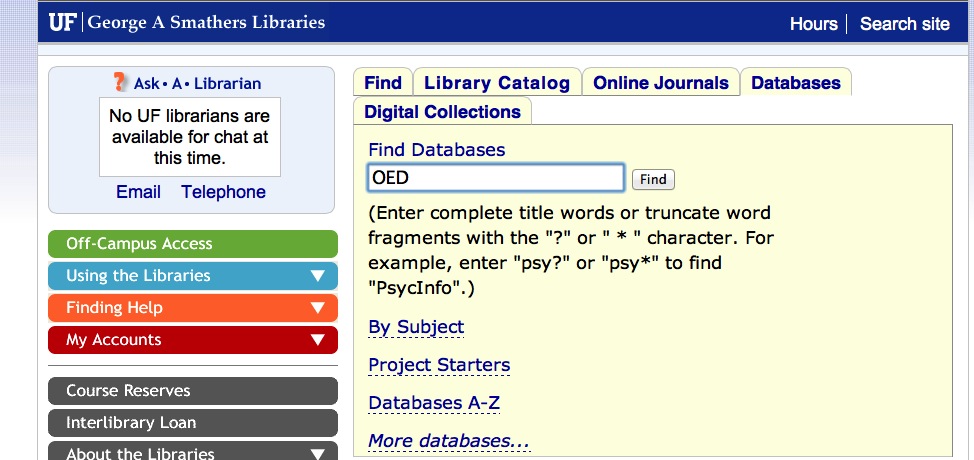
You will get to this page. Double click on "Oxford English Dictionary."
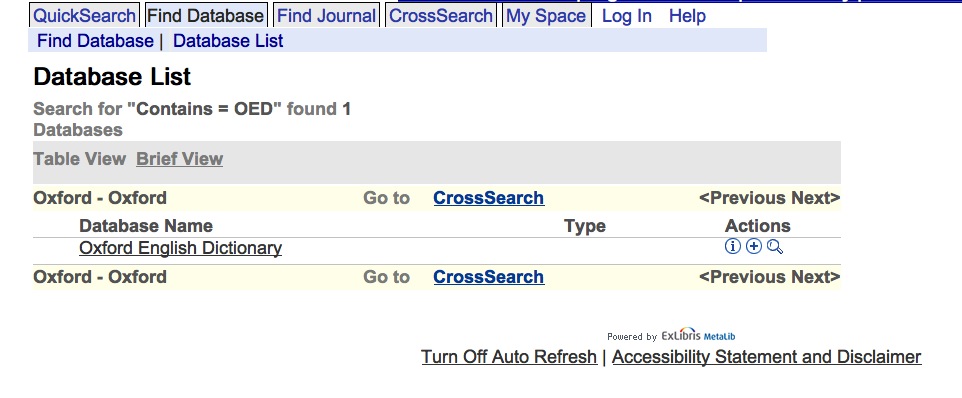
You will get to OED at this page, where you can look up words of interest.

To save time for class disucssion of the readings and / or films, I have put these policies online. Please read this page now and please read botht he short versions and the long version carefully.
Short Version:
This class cannot work unless you want to be here.
In other words, if you're going to be here, you really have to be here.
Therefore, in order to really be here, you have to want to be here.
In short, if you are going to be here, you really have to be here.
Long Version:
1. Preparation for class discussion. The price of admission to class is to bring a print, not electronic, copy of the readings with you to class. That means you will need to bring the original or a xerox. The printed out readings are your ticket. I will ask you to take them out at the beginning of class. Again, a paper copy is necessary. Kindles and pdfs on computers are not valid. Kindle and other ebook editions do have not have page numbers and do not have the same scholarly apparatus that print editions of books do. They are therefore unsuitable for class discussion. I prefer paper to electronic documents because the former is a codex, a random access machine, and far superior to online documents, all of which are scrolls, the storage device the codex replaced thousands of years ago. Kindles and other ebooks have no page numbers. Although it is possible to annotate online documents, it is much easier to annotate a paper document and to remember and find what you annotated or underlined where you did. You can even take longer notes on the flyleaves of a book. Some electronic documents have one advantage over paper documents: you can search a pdf or a kindle for a particular word or phrase and find it immediately. An electronic document that has been scanned from paper cannot be searched, however. You need to bring a copy of the assigned articles or book to class the day we are discussing it in detail, reading it closely. If you don't have a copy you cannnot effectively participate in class. Therefore, you must have a copy to be counted as present. Since we'll be talking about the readings in some detail, you'll need to be able to turn to the page we're discussing. If you do not have a print out, paper copy of the reading or readings, your own personal copy, I will ask you to go home.
2. Discussion questions. If you don't turn in the discussion questions, I count you as absent. In addition to writing the DQs, I ask that you write any "big" words you had to look up and their definitions. Depending on your vocabulary, you may need to look up a lot of words or only one or two. DQs without "big" words and their definitions will not count as passing work.
3. Lateness: If you come late to class after the second week of the semester. you will automatically fail the course. If you are taking a class that begins at 8:30, make sure you get up early enough to make it class on time. If you are thiking of taking a bus that may be late from time to time, take an earlier bus. Think of arriving to class as you would arriving for an airplane flight. Get there early or you will miss the class, just as you miss yor flight if you arrived late. I have adopted this policy because a late arrival is a disruption of the class (as is sleeping in class). By the third week of the semester, if you are one second late or twenty minutes late or any other amount of time late, the penalty you meet will be the same: an "E" in the course.
4. On two period class days, I will have us take a brief break (a minute or two) in the middle of class. If you have not made a reasonably valuable comment on the readings by then, I will ask you to go home rather than remain an uninspired bump bringing the mood of the class down. By "reasonably valuable comment" I mean a comment that make dense in he context of the discussion. Talking just to blurt out an irrelevant comment is not valuable. You will not receive better than a "C" in the course if you do not attend and participate in class. So even if all your written work is "A" level (or "B") but you have not participated in class discussion, you will receive a "C" for the course.
5. Attendance: Class attendance and participation are crucial to the success of this course. By "attendance" I mean not only being in class, but includes completing the assigned work for each class by the time it is due and arrving to class on time. (If you arrive late to class or if don't do the discussion questions, you are counted as absent.) By participate, I mean attend class, do the discussion questions, and speak up usefully in class so that a given conversation moves forward. Talking but not adding anything is not participating. You can participate by bringing up a topic, adding to someone else's point, or disagreeing, among other ways. Just making random comments that lead us nowhere does not count as participartion. If, in addition to not participating, you don't turn in written work, you will not pass the course. I take attendance, and late arrivals will be counted as absent. After the first few classes, when I have learned your names, I will take roll silently in class instead of taking it aloud.
You may miss two classes for whatever reason without offering an explanation to me. If you are absent one time or two times, in other words, do not give me an excuse. None is needed and none will be heeded. Missing more than two classes (for whatever reason) may result in a reduction of your final grade for the course, the degree of the reduction to be determined by me at my discretion (depending on the circumstances, I may not lower your final grade at all or I may lower your final grade to an "E"). Missing four classes (or more) means either that you need to withdraw from the course or that, if you do not withdraw, you will get an "E" as your final grade.
Theodor Adorno, Richard Leppert (Editor), Susan H. Gillespie Essays on Music
Written and Related Work: Co-lead class discussion twice, once on a Tuesday and once on a Thursday, discussion questions for each class; and two 500 word papers.
Class attendance and participation are crucial to the success of this course. You will not receive better than a "C" in the course if you do not participate in class. (By participate, I mean attend class, do the discussion questions, and speak up usefully in class so that a given conversation moves forward. You can bring up a topic, add to someone else's point, or disagree. Just making random comments that lead us nowhere does not count as participation. If, in addition to not participating, you don't turn in written work either, you will not pass the course. I take attendance, and late arrivals will be counted as absent. If you don't bring the reading with you, I count you as absent.
LATE WORK WILL NOT BE ACCEPTED.
Ground rules for class:
Please email me only to send me your assignments. Otherwise, contact me in person after class or during office hours.
No breaks during class (plan ahead).
Turn off your lap-top computers, ipads, and cell phones during class.
Come to class on time. If you enter after the door to the classroom has closed, I will consider you late; and I will count you as absent.
Please turn off your cell phones during class. Do not leave during class. If you do, I will you count you absent.
Please put your last name first in the subject header of all microsoft word documents you send me. Example: Bush.doc
Please put your first and last name at the bottom of your discussion questions.
Please put your last name in the title of all word documents you email me. Here's an example: Burt.doc Be sure to put your name in the word document and title your paper descriptively (not "Paper #1") too!
Please email me only to send me class assignments. Otherwise, please talk to me after class or during office hours.
ALL WRITTEN WORK YOU SEND ME BY EMAIL MUST BE MICROSOFT WORD DOCUMENTS.
If you have any questions about the course, please ask them of me in class or during office hours. Contact me by email only to send me your assignments. Also, put your last name first in the title of any attached document you send me and put you name in the word documents.
NB: When doing your papers, I expect you to be able to "quote" images from the film. By "quote" I mean capture images and insert them into you word documents. In other words, you must be able to capture a image from the DVD of each shot and insert it into your text. I require screen captures because they actually help you "read" the film as well as give your reader more information. It's like writing about a poem from memory without being able to quote any lines versus having the poem in front of you and being able to quote lines from it.
PLEASE NOTE that the schedule webpage for this course is tentative and may be frequently revised during the semester. You may wish to print out a copy, but do check the website before each class to double check for any changes. The current version of this website is the binding one.
Please download all online readings now at the UF e-course reserve webpage. Create a folder on your computer and put them in it. If you are unable to access the readings, I don't consider that a valid excuse for not reading them, turning in discussion questions on them, printing them out, and and bringing them to class.
All documents should be formatted using Ariel 12 point font.
To Repeat: All assigned work for the course must be completed and be of passing quality to pass the course. This is not a course where you can do 70 percent of the work and expect to get a C in the course. To get a C in the course, you need to do 100 percent of the work at C level. Because of the number of students in the class, I may not notice that you have not been completing the work until the end of the term. In that case, you will receive an E.
1. Co-leading class with one or two other students on a Thursday. Though this class is relatively large, I will not run it as a lecture. Instead, I will ask 2-3 of you, in consultation with me, to lead class once during the term. You will lead class discussions. I will talk with you in advance about how to prepare and I will of course also participate in discussion. I will ask each one of you to prepare a close analysis of one scene from the film of your choice. You need to let each other know which scene you want to do so that you don't duplicate each other's efforts. Also, please cc me in your email correspondence. Thanks. To get credit for this part of the course, you must email me and the other students leading discussion your notes and questions (at least two pages) 24 hours before the class you'll lead.
2. Report in class on a Thursday (on a film or text I will discuss with you).
2. Discussion Questions. Two discussion questions on each reading on Tuesdays and two discussion questions eon each film discussed on Thursdays are due by 5 p.m. the day before the readings or film are discussed in class. Please put your name after the questions you email me at the bottom of your email. Please print out the questions after I post them either online or by email, read them over, and then bring the print out with you to class.This format can work extremely well, but it can only work and work well if all of you are equally prepared for discussion and only if you in fact do participate in class. You should be just as prepared to discuss on days you are not leading discussion as on days you are. The point of the questions is (a) that you do the readings and watch the films carefully (analytically); (b) that you come prepared to class to talk about the reading or film concretely; and (c) that you get practice for writing your papers and flim clip exercise (your papers will depend on your noticing the kinds of things in the readings and film that draw you to formulate questions about them. To this end, I will ask all of you email me two discussion topics (3-4 sentences) and discussion questions (at least one) about each reading and each film assigned for each class. I will then post these questions with your names on the course website or email them to you via the class email listerv before class. The day you lead class, you need not do the discussion questions. Please put the name of the class in your email title, and please put your name in your emailed topic / discussion questions after your questions. (That just makes it easier for me to copy them on to this page.) Please make sure the questions are your own (taking them from imdb, wikipedia, or any other uncredited source is plagiarism), and please make them as concrete as possible (addressed to a specific aspect of the reading or film). Please limit your question to the film itself (don't bother with production or reception histories). Your questions should arise from a close reading of the film or reading. Your questions may or may not come up in class, but all students should read all of them.
Be sure to bring the assigned book or a print copy of all assigned eletronic readings and bring it with you to class. If you don't bring the reading(s) with you, I count you as absent.
3. No unexcused late work will be accepted.
5. All assignments (double spaced, and that includes indented quotations) in Ariel 12 point font must be electronically delivered to me via email in a Microsoft Word document at
6. Attendance. You may miss two classes for whatever reason without offering an explanation to me. Attendance includes completing the assigned work for each class and being to class on time. (If you don't do the discussion questions, for example, you are counted as absent.) Your physical presence in class is not enough for you to be counted as present. If you come to class late or if you come to class without having completed the assignment for that class, I will count you as absent. After the first few classes, when I have learned your name, I will take roll silently in class. You may miss one class for whatever reason without offering an explanation to me. Funerals, colds, weddings, etc., are all covered by the two absences. Be sure to bring the assigned book or print copies of all assigned electronic readings and bring it with you to class. If you don't bring the reading(s) with you, I count you as absent. You will not receive better than a "C" in the course if you do not participate.
7. Please arrive to class on time. It's just a common courtesy to me and to your fellow students. In addition to being irritating, lateness is not excused, and late arrivals will be counted as absent. Please turn off your cell phone.
8. Please be sure to bring the assigned reading(s) to class the day we are discussing it or them. We'll be reading a lot of often difficult material very closely, and it will be essential that you have the text open in front of you.
9.
10. Please put your last name in the title of all word documents you email me. Be sure to put your name in the word document too!
11. It is your responsibility to check the schedule webpage before each class and complete all assignments on time. If you miss work and do not contact me to ask about an excuse, you will not receive credit, nor will I notify you. It is your responsibility to be aware of any assignments and either complete them or notify me and explain why you could not complete them should you have a valid excuse.
12. UF policy mandates that all students have access to a computer. You will need to access a computer and your email daily, and if you have a problem doing so on a particular day, it is responsibility to let me know in class and turn in any assigned work due on paper at the beginning of the class it is due.
13. Extra credit work is not an option, nor is make up work for unexcused classes.
14. If you miss a conference or other appointment to see me in person and then miss it without having cancelled at least 24 hours in advance, I won't reschedule the appointment.
15. To receive a "C" or above on your written work, your written prose must be free of grammatical errors, spelling errors, and typos.
16. There will be a number of unannounced pop quizzes in class. If you fail a pop quiz, I will count you as absent that day.
17. Final Grades:
Your final grade for the course will be based on the how you meet the following criteria:
i. Participation, including in class pop quizzes, and film analysis quizzes: 30 percent. You must participate in class disussion to get better than a "C" grade in this course. In addition to talking in class (5 percent), participation breaks down into three other components. (A) Leading classes: 10 percent . (The days you lead class, you need not do the discussion questions.) To get credit for this part of the course, you must email me and the other students leading discussion your notes and questions (at least two pages) 24 hours before the class you'll lead or give a report.; (B) discussion questions for each class: 10 percent (pass / fail). and (C) pass pop quizzes in class (5 percent). If you fail a quiz, I will count you as absent that day. Passing this part of the course requires that you complete all of the discussion questions; moreover, each set of discussion questions must be thoughtful contributions, not perfunctory exercises, in order to receive passing credit. Please remember to put your name at the bottom of the email, after the three (or more, depending on the number of readings) questions. (The day you lead class, you need not do the discussion questions.) Print out copies of all assigned online readings and bring them to class. If you don't have copies of these readings with you in class, I will mark you as absent.
ii. A film clip analysis exercise and two persuasive (analytical) essays of 500 words each, twelve point font microsoft word document. Going under or over the word count means a failing grade. Focus your papers on a theoretical problem raised by the readings in relation to two films, one a Western and one film noir. on one or two scenes from each film. Read the texts and films closely to make both a point about specific passages and specific scenes, and, by extension, about the films from which the scenes are taken. I strongly recommend making use of relevant image captures (with eight as the maxmimum). Your papers not opinion pieces (like newspaper movie reviews), but analytical, persuasive essays. See the paper guidelines webpage. For due dates, please see the scehdule webpage. (Email each paper to me at. Please put your last name first in the microsoft word documents you email or pando me. Example: Burt.doc
iii. Pass film analysis quiz in class.
All parts of the course (i-iii above) must be completed and turned in on time to pass the course.
All assigned work for the course must be completed and be of passing quality to pass the course. This is not a course where you can do 70 percent of the work and expect to get a C in the course. To get a C in the course, you need to do 100 percent of the work at C level. Because of the number of students in the class, I may not notice that you have not been completing the work until the end of the term. In that case, you will receive an E.
Class attendance and participation are crucial to the success of this course. You will not receive better than a "C" in the course if you do not participate. (By participate, I mean attend class, do the discussion questions, and speak up usefully in class so that a conversation moves forward. Just making random comments that lead us nowehere does not count as participartion. If, in addition to not partiicpating, you don't turn in written work either, you will not pass the course.)
Plagiarism. I expect that all written work turned in by you will be your own. Be sure to cite all outside sources, if you use any, and to attribute any quotations you use to their source(s). To learn how to reference source material properly, go to Diana Hacker's online Research and Documentation guide (Bedford Books/St. Martin's Press), which includes a section on citing electronic sources. Failure to do so constitutes plagiarism, a violation of the University's policies on academic honesty, and will result in an "F" for the course. If you have any questions about how to cite or quote secondary works or about what is or is not plagiarism, please ask me for clarification BEFORE you turn in your written work. You will not be penalized for asking, and I will be happy to answer any questions you may have.
Email Ettiquette: All assigned work for the course must be completed and be of passing quality to pass the course. This is not a course where you can do 70 percent of the work and expect to get a C in the course. To get a C in the course, you need to do 100 percent of the work at C level. Because of the number of students in the class, I may not notice that you have not been completing the work until the end of the term. In that case, you will receive an E.
Please put your last name first in the subject header of all microsoft word documents you send me. Example: Bush.doc
Please put your first and last name at the bottom of your discussion questions.
Please put your last name in the title of all word documents you email me. Here's an example: Burt.doc Be sure to put your name in the word document and title your paper descriptively (not "Paper #1") too!
Please email me only to send me class assignments. Otherwise, please talk to me after class or during office hours.
ALL WRITTEN WORK YOU SEND ME BY EMAIL MUST BE MICROSOFT WORD DOCUMENTS.
If you have any questions about the course, please ask them of me in class or during office hours. Contact me by email only to send me your assignments. Also, put your last name first in the title of any attached document you send me and put you name in the word documents.
Also, and this is VERY IMPORTANT, please be aware that this class will make extensive use of the course website and email. The current version of the website is the binding one. Please make sure that if you have you do not currently access your gatorlink email account that you have all email from that account forwarded to your current email acount. I will be emailing you all through a class listserv, and this listserv uses your "@ufl.edu" gatorlink email address. Typically, I will be sending you several emails a week, so make sure that you are able to get them.