
The Italian original is on the left. You need not read it.
| Amor, che nel penser mio vive et regna e 'l suo seggio maggior nel mio cor tene, talor armato ne la fronte vene; ivi si loca et ivi pon sua insegna. Quella ch'amare e sofferir ne 'nsegna, e vol che'l gran desio, l'accesa spene, ragion, vergogna, e reverenza affrene, di nostro ardir fra se stessa si sdegna. Onde Amor paventoso fugge al core, lasciando ogni sua impresa, et piange et trema; ivi s'asconde et non appar piu fore. Che poss'io far, temendo il mio signore, se non star seco infin a l'ora estrema? che bel fin fa chi ben amando more. |
Love, who lives and rules in my thought and holds his chief seat in my heart, sometimes armed comes into my face; and there makes camp and places his banner. She who teaches me to love and suffer, and wants reason, shame, and respect restrain my great desire and burning hope takes offense inwardly at our ardor. Therefore Love, fearful, flees to the heart, abandoning it all, and cries and shakes; he hides himself, and is seen abroad no more. What can I do, when my master is afraid, except stand with him to the bitter end? He makes a fine end, who dies loving well! |
2. Compare the translations of Petrarch's Rime 140 below by Sir Thomas Wyatt and Henry
Howard, Earl of Surrey. Which translation is better? Why?
| Sir Thomas Wyatt | Henry Howard, Earl of Surrey |
| The long love that in my thought doth harbor, And in mine heart doth keep his residence, Into my face presseth with bold pretense And therein campeth, spreading his banner. She that me learneth to love and suffer And wills that my trust and lust's negligence Be reined by reason, shame, and reverence With his hardiness taketh displeasure. Wherewithal unto the heart's forest he fleeth, Leaving his enterprise with pain and cry, And there him hideth, and not appeareth. What may I do, when my master feareth, But in the field with him to live and die? For good is the life ending faithfully. |
Love, that doth reign and live within my thought, And built his seat within my captive breast, Clad in the arms wherein with me he fought, Oft in my face he doth his banner rest. But she that taught me love and suffer pain, My doubtful hope and eke my hot desire With shamefast look to shadow and refrain, Her smiling grace converteth straight to ire. And coward Love, then, to the heart apace Taketh his flight, where he doth lurk and plain, His purpose lost, and dare not show his face. For my lord's guilt thus faultless bide I pain, Yet from my lord shall not my foot remove: Sweet is the death that taketh end by love. |
3. Read rime 129 below. Again, you may skip the Italian original.
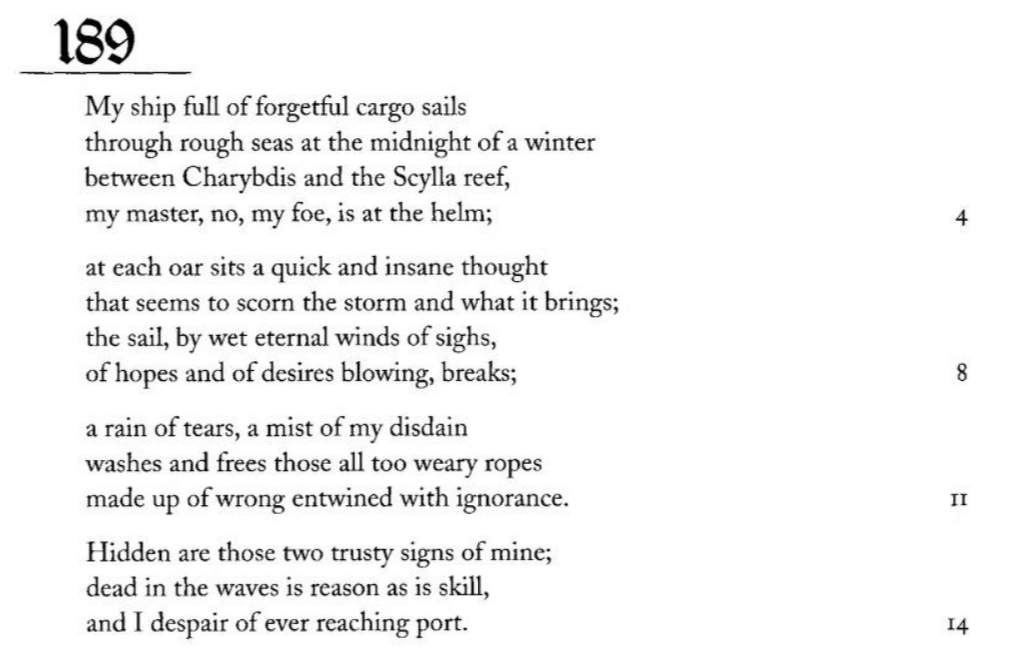
4. Read Sir Thomas Wyatt's translation of rime 189. Why is it better the modern translation above?
Sir Thomas Wyatt My Galley Charged with Forgetfulness
My galley, chargèd with forgetfulness,
Thorough sharp seas in winter nights doth pass
'Tween rock and rock; and eke mine en'my, alas,
That is my lord, steereth with cruelness;
And every owre a thought in readiness,
As though that death were light in such a case.
An endless wind doth tear the sail apace
Of forced sighs and trusty fearfulness.
A rain of tears, a cloud of dark disdain,
Hath done the weared cords great hinderance;
Wreathèd with error and eke with ignorance.
The stars be hid that led me to this pain;
Drownèd is Reason that should me comfort,
And I remain despairing of the port.
Sir Philip Sidney, Astrophil and Stella 3: Let dainty wits cry on the sisters nine
Let dainty wits cry on the sisters nine,
That, bravely mask'd, their fancies may be told;
Or, Pindar's apes, flaunt they in phrases fine,
Enam'ling with pied flowers their thoughts of gold.
Or else let them in statelier glory shine,
Ennobling newfound tropes with problems old;
Or with strange similes enrich each line,
Of herbs or beasts which Ind or Afric hold.
For me, in sooth, no Muse but one I know;
Phrases and problems from my reach do grow,
And strange things cost too dear for my poor sprites.
How then? even thus: in Stella's face I read
What love and beauty be; then all my deed
But copying is, what in her Nature writes.
B. William Shakespeare, Sonnet 130: My mistress' eyes are nothing like the sun
My mistress' eyes are nothing like the sun;
Coral is far more red than her lips' red;
If snow be white, why then her breasts are dun;
If hairs be wires, black wires grow on her head.
I have seen roses damasked, red and white,
But no such roses see I in her cheeks;
And in some perfumes is there more delight
Than in the breath that from my mistress reeks.
I love to hear her speak, yet well I know
That music hath a far more pleasing sound;
I grant I never saw a goddess go;
My mistress, when she walks, treads on the ground.
And yet, by heaven, I think my love as rare
C. John Donne, "The Apparition"
D. George Herbert, "Holy Scriptures II"
Oh that I knew how all thy lights combine,
And the configurations of their glory!
Seeing not only how each verse doth shine,
But all the constellations of the story.
This verse marks that, and both do make a motion
Unto a third, that ten leaves off doth lie:
Then as dispersed herbs do watch a poition,
These three make up some Christian's destiny:
Such are thy secrets, which my life makes good,
And comments on thee: for in ev'ry thing
Thy words do find me out, and parallels bring,
And in another make me understood.
Stars are poor books, and oftentimes do miss:
This book of stars lights to eternal bliss.